

















In 2025, Patrick McGee published Apple in China: The Capture of the World’s Greatest Company, a deeply-reported look at the tech giant’s investment in — and growing reliance on — China.
The following excerpt, pulled from Chapter 9 of Apple in China, examines the company’s relationship with Foxconn, today the infamous builder of iPhones. Foxconn wasn’t always a formidable company, though. As McGee’s reporting illustrates, its exponential growth was thanks in large part to founder Terry Gou’s cultivation of a relationship with Apple. That relationship played a huge role in taking the company from a supply outlet for affordable components to, today, the world’s largest electronic manufacturer.
From the founding of Communist China in 1949 until 1978, mainland China was largely shut off from outsiders as it underwent multiple up-heavals. Mao might have been proficient as a military commander, but as a national leader he was paranoid and domineering, driven by a bastardized form of Marxism. Before Mao became head of state, the country had just undergone what the Chinese call their “century of humiliation,” a humbling period when the world’s top economy for countless generations suffered repeated military defeats by British, French, and Japanese forces. In centuries past, China had been a technological powerhouse that had invented gunpowder, the printing press, the compass, and paper. Mao wanted to catch up to industrialized countries, but his Great Leap Forward was a catastrophe, resulting in famine that killed 30 million to 45 million people. Mao’s next act was the Cultural Revolution, a whirlwind decade beginning in 1966 meant to purify Communism. Students organized as Red Guards were encouraged to attack “the four olds”: old customs, old culture, old habits, and old ways. By the time Mao died in 1976, China was poorer than sub-Saharan Africa.
In the final years of the 1970s, as Terry Gou was developing a real technical expertise with electronics, China’s economy entered a transformative phase initiated by Mao’s successor, Deng Xiaoping. As part of his “reform and opening up” policies, Deng established several special economic zones on the eastern coast—areas open to capitalist experimentation— which flourished by drawing in foreign investment and millions of rural workers from inland China. Entrepreneurs in Hong Kong, a British colony at the time, were the first to invest heavily, combining “Third World costs” with “First World caliber management, infrastructure, and market knowledge.”

The result was a remarkable boom unprecedented in world history: the Middle Kingdom, a country of more than a billion people, opened to the world, modernized at a frenetic pace, and grew some 10 percent a year for three decades. Hundreds of millions of people were lifted from poverty. As early as 1984, President Reagan was calling China “a so-called Communist country,” suggesting that as the country planted the seeds of economic reform, the flower of political reform would bloom. In 1980, Shenzhen was a fishing village of fewer than 70,000 people. But as a special economic zone just across the harbor from Hong Kong, Shenzhen and the area around it underwent a metamorphosis. “By the late 1980s, the entire 104-mile route from Hong Kong to Guangzhou was lined on both sides with factories,” according to the late Ezra Vogel, a Harvard scholar and the biographer of Deng Xiaoping. By 1990 the city of Shenzhen had a population of 1.7 million; in the early 2000s, it had grown to around 7 million. In just twenty-five years, Shenzhen’s population grew a hundredfold.
Quality was often horrendous by Western standards. A manufacturing design engineer at Apple recalls visiting Shenzhen-based suppliers in buildings that would fail a regulatory test on a mere glance, let alone a deep audit. “There weren’t elevators, so you’d walk the stairs,” this person says. “And I’d count the stairs. There might be twelve between the first and second story, then eighteen stairs to the next floor, then sixteen, and then twenty-four.” The stairs themselves were sometimes ten inches in height, sometimes seven, and so on. “My point is those buildings were handmade,” he says. Everything was done in a slapdash manner. Speed and scale were the only priorities. Apple engineers sent to Shenzhen describe the city as a rough place back then. When one engineer, six-four, tried walking out of the hotel to go for an evening stroll, the concierge stopped him and warned it was too dangerous. “I’m a big guy,” he said, dismissing their worries. “A dozen monkeys can kill a gorilla,” the concierge responded.
More than any area in China, the province of Guangdong transformed the fortunes of the world’s most populous country. Shenzhen in particular became a hub for electronics, earning it the nickname the Silicon Valley of Hardware. The journalist James Fallows, who lived in China in the late 2000s, has argued that Terry Gou ranks second only to Deng Xiaoping in transforming China into an industrial behemoth over the previous fifty years. That’s an extraordinary claim, but one backed up even by Gou’s rivals. “The reason Shenzhen is Shenzhen is Terry Gou,” says a high-ranking contract manufacturing executive. “Without his ambition, Shenzhen wouldn’t be the manufacturing power it is.”
Yet it’s worth highlighting how recently Foxconn developed this reputation. In 1999, it was a company with $1.8 billion of revenue, far smaller than Solectron, SCI, or Flextronics, its US rivals. By 2010, Fox-conn revenues were $98 billion, more than those of its five biggest competitors combined. And Foxconn’s extraordinary growth in those eleven years is the consequence of one client more than any other: Apple.
The Apple-Foxconn relationship goes back to at least the early 1990s, but in a limited way. Foxconn had been championed by H. L. Cheung, a Singaporean Apple executive from 1981 to 1997, who would later join Foxconn. But Terry Gou’s company was mostly just a supplier of affordable components, like those connecting printed circuit boards to the housing. Apple engineers from the mid-1990s remember it as “the connector company.” But Foxconn quickly expanded its skill set, and approaching the year 2000, it was demonstrating its prowess as a jack-of-all-trades with a model different from the other Taiwanese companies expanding to the mainland.
The business of assembling electronics for Western brands was cutthroat, so the big trend at the time was to hire expensive engineers and designers, invest in R&D, and take on more responsibility for the client.
This got to the point where an IBM clone brand could pick its PC designs out of a catalogue produced by groups like ASUS, Inventec, and Acer. These original design manufacturers, or ODMs, would design the model, build it, badge it with a Western logo, and ship it. This work was higher margin than mere assembly, so it worked nicely for the Taiwanese companies. And it offered Western PC brands the distinct advantage of offloading even more of their fixed costs—not just manufacturing, but design and R&D. However, it involved a distinct risk. It didn’t take much for ASUS and Acer to expand into branding and marketing themselves.
Soon they were selling computers under their own name and competing with their clients. It was a logical step, but one that irked the Western PC brands. They’d ask, “How can I trust you if I’m competing with you?” says Willy Shih, who teaches at Harvard Business School. Their concerns were aggravated in times of component shortages, because a group like Acer would be incentivized to allocate parts to its own PC division.
“How can I trust you if I’m competing with you?”
Gou took a different tack. He shunned being an ODM, not liking the costs of hiring expensive talent to design products. Instead, he touted a vertical integration strategy, in which Foxconn would aim to control the bill of materials as much as possible, either by building the key components itself or sourcing them in bulk. Then it would focus on the client, not just on one particular product, one particular design, but by investing in long-term partnerships. Foxconn championed being an original equipment manufacturer, a model widely derided as second class. Unlike the ODMs, a good OEM makes no effort in design or branding, but it will move heaven and earth to respond to the client’s manufacturing needs. This narrow focus allowed Foxconn to go several layers deep in the supply chain and achieve greater scale. More scale required a bigger footprint and more laborers—the key ingredients for a successful relationship with local bureaucrats.
Terry Gou wasn’t any more enthused about low-margin assembly than his ODM rivals. Assembly was just a power grab. It offered him the chance to take care of sourcing components, from his own subdivisions and from third parties, which opened further opportunities. “One of the ways Foxconn can make money is PPV, or purchase price variance,” says David Johnson, an Apple tooling engineer from the time. “If they can control your supply chain for you—if they take that off your hands—then they can make more money. They’ll sell a cable to you for a dollar, but they will buy it for thirty-five cents. So they can make money through all the channels. And the more parts they control for you, the more opportunity there is to make money.”
Foxconn began offering final assembly on the cheap for the same reason Costco sells hot dogs: It gets people in the door. Foxconn then upended the world of tooling by giving it away for free. That is, Gou would offer to pay the up-front costs of establishing the custom molds, dies, fixtures, and other equipment necessary to start building a product at scale. “That can be half a million or a million dollars,” says a former Apple engineer. “And that was absorbed by the manufacturer—by Foxconn. So Apple just paid for the production parts.” Then Foxconn would work to integrate all procurement, manufacturing, and logistics into a one-stop shop. It made its money back the same way a mobile carrier might—giving customers a free phone but earning fees in a two-year contract. This Apple engineer describes Gou’s approach as a wily bet to lure in Western companies, getting them hooked on the drug of cheap production, and creating a sticky relationship based on Foxconn’s choice of components. “Once they get you in the door, that’s it—they control you,” he says. “Foxconn isn’t called ‘Fox-con’ for nothing. Terry Gou was a gambler, and the real name of the company is Hon Hai. That was changed to Foxconn because he’s a fox, and he’s a con artist.”
“Foxconn isn’t called ‘Fox-con’ for nothing.”
By having a role in so many areas, across several products and down multiple tiers to the sourcing of raw materials, Foxconn was putting itself in a position to scale much faster than its rivals. Longer-term projects allowed it to hire thousands of laborers, then shuffle them around to wherever work was needed. To retain workers and deploy them to different lines on a whim, Gou built the Longhua campus into a dense city within a city, replete with restaurants, markets, entertainment venues, basketball courts, and subsidized dorms. This approach gave rise to a major industrial cluster north of Shenzhen, bulking up his reputation among government officials. Upon scoring political points, Gou could redeem them for better access to land, migrant labor, and cutting-edge machinery.
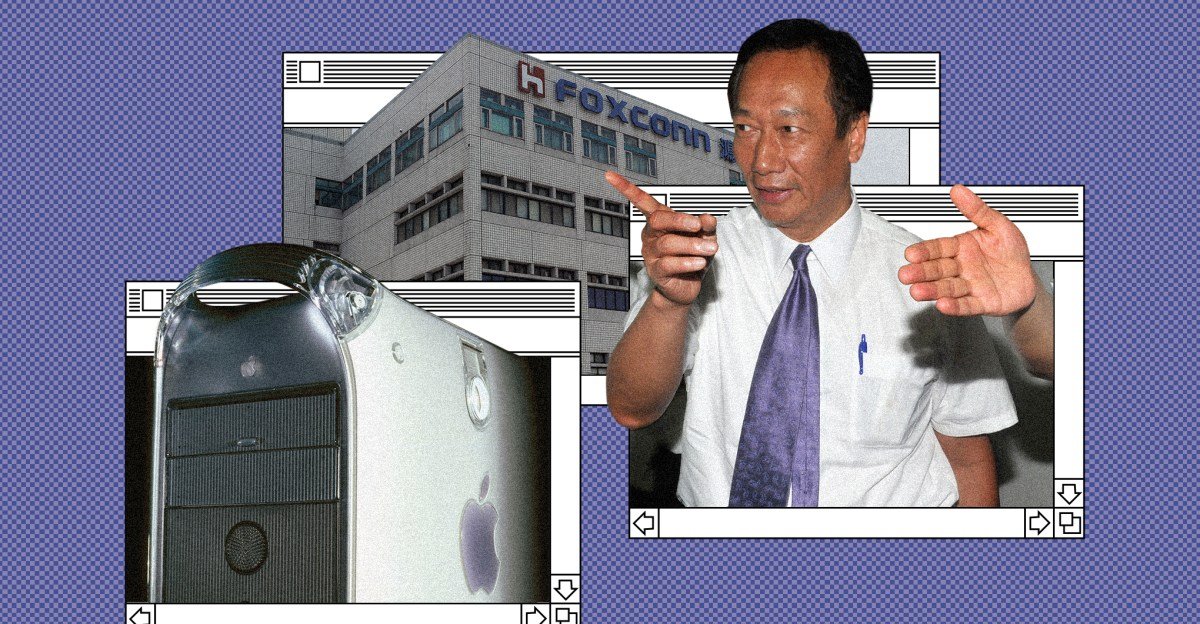
In 1999, Foxconn won an order to build the enclosure—the external housing—for Apple’s Power Mac G4 desktop, a dazzling white-and-graphite computer featuring a semi-translucent, frosted plastic shell and integrated, curved handles. The enclosure was already being made by Singapore Shinei Sangyo, known as “triple S.” It had been a trusted supplier to Apple for a decade, building tools Apple would import to its manufacturing facilities in Ireland and California. As demand for the Power Mac increased and Apple sought to cut costs, Foxconn was brought in as a second supplier. There was nothing unusual about this; it was a common move for diversification and resiliency. What was unusual was how well Hon Hai performed. “Foxconn kicked our rice bowl,” recalls a mechanical engineer at SSS. It was the first instance that Gou demonstrated to Apple not just his eagerness and commitment, but also his talent.
So as LG struggled with its strategy to build iMacs on three continents, Gou recognized an opportunity for an even larger order with Apple. That’s when he made the historic phone call, telling an Apple executive, “I can fix this.” The call he made wasn’t to just anyone, but to the senior vice president Steve Jobs had hired less than a year earlier to overhaul operations. His name was Tim Cook.