



• About
  • Advertise
  • Privacy & Policy
  • Contact
Tech News, Magazine & Review WordPress Theme 2017
  • Home
  • Review
    LG’s RGB LED TV is good for certain situations, but an OLED is better

    LGs RGB LED TV is good for certain situations, but an OLED is better

    The Telo MT1 is a big truck trapped in a tiny truck’s body

    The Telo MT1 is a big truck trapped in a tiny trucks body

    My brief romance with an AI bird feeder

    My brief romance with an AI bird feeder

    Instinct was the buzziest AI agent around — can it survive Muse?

    Instinct was the buzziest AI agent around — can it survive Muse?

    A week with Googlebooks: four notes from our testing so far

    A week with Googlebooks: four notes from our testing so far

    Microsoft’s new Windows Search is exactly what Windows 11 needs

    Microsofts new Windows Search is exactly what Windows 11 needs

  • Gaming
    Decade-old RAM is making a comeback

    Decade-old RAM is making a comeback

    The humble Playdate has become one of gaming’s best deals

    The humble Playdate has become one of gamings best deals

    AMD will bring FSR 4 to handhelds by the end of 2026

    AMD will bring FSR 4 to handhelds by the end of 2026

    Paramount is making a Cyberpunk 2077 film

    Paramount is making a Cyberpunk 2077 film

    I only bought Pokémon Legends: Z-A during Prime Day, and it’s still on sale

    I only bought Pokémon Legends: Z-A during Prime Day, and its still on sale

    Forza Horizon 6 is being delayed on PS5 to January 2027

    Forza Horizon 6 is being delayed on PS5 to January 2027

  • Gear
    • All
    • Audio
    • Camera
    • Laptop
    • Smartphone
    Microsoft tries to spark new life into Windows

    Microsoft tries to spark new life into Windows

    Android’s physical navigation buttons are back on Googlebooks, but not the way you think

    Android’s physical navigation buttons are back on Googlebooks, but not the way you think

    Google admits not every Android app runs great on Intel Googlebooks

    Google admits not every Android app runs great on Intel Googlebooks

    The forgotten Chromebook that started it all

    The forgotten Chromebook that started it all

    HP’s answer to the MacBook Neo is thinner, lighter, and comes with OLED

    HP’s answer to the MacBook Neo is thinner, lighter, and comes with OLED

    Huawei made a whole camera to attach to its latest phone

    Huawei made a whole camera to attach to its latest phone

    Trending Tags

    • Best iPhone 7 deals
    • Apple Watch 2
    • Nintendo Switch
    • CES 2017
    • Playstation 4 Pro
    • iOS 10
    • iPhone 7
    • Sillicon Valley
  • Computers

    To regain advertiser trust, Facebook is tracking ads by the millisecond

    Google has been asked to take down over a million websites

    Watch Dogs 2 Update Coming This Week, Here’s What It Does

    Fujifilm X-T2 review: The definition of a great camera

    Shopify CEO attempts to defend continued hosting of Breitbart’s online store

    SpaceX targets February 18 for Dragon resupply mission to ISS

  • Applications
    Apple and LG leak shows new ‘tap to control’ HomeKit features

    Apple and LG leak shows new ‘tap to control’ HomeKit features

    Apple will reportedly debut its first touchscreen MacBook in three weeks

    Apple will reportedly debut its first touchscreen MacBook in three weeks

    Tim Cook says ‘I’m not meddling’ in the new Apple CEO’s business

    Tim Cook says ‘I’m not meddling’ in the new Apple CEO’s business

    Apple announces surprise ‘Welcome home’ launch event

    Apple announces surprise ‘Welcome home’ launch event

    The Apple Watch Series 12 is a good deal at $50 off

    The Apple Watch Series 12 is a good deal at $50 off

    New leaks provide our first look at Apple and LG’s smart home devices

    New leaks provide our first look at Apple and LGs smart home devices

  • Security

    To regain advertiser trust, Facebook is tracking ads by the millisecond

    National Academy of Sciences endorses embryonic engineering

    Google has been asked to take down over a million websites

    Watch Dogs 2 Update Coming This Week, Here’s What It Does

    The Warby Parker of hair color, Madison Reed, scores new funding and a CMO

    Shopify CEO attempts to defend continued hosting of Breitbart’s online store

No Result
View All Result
earmpro - Latest Tech News & Reviews
No Result
View All Result
Home Apple

Apple II Forever!

admin by admin
March 31, 2026
Apple II Forever!
Share on FacebookShare on Twitter

This is part of our package about Apple’s 50th anniversary, read more here.

When you think of Apple, you probably think of the iPhone, or maybe the Mac, or perhaps you’ve got fond memories of the iPod. But Apple’s 50-year run of creating tech products that people fall in love with — sometimes a lot of people, sometimes just a hardy few — would never have happened if it weren’t for a product and platform that’s been gone for decades.

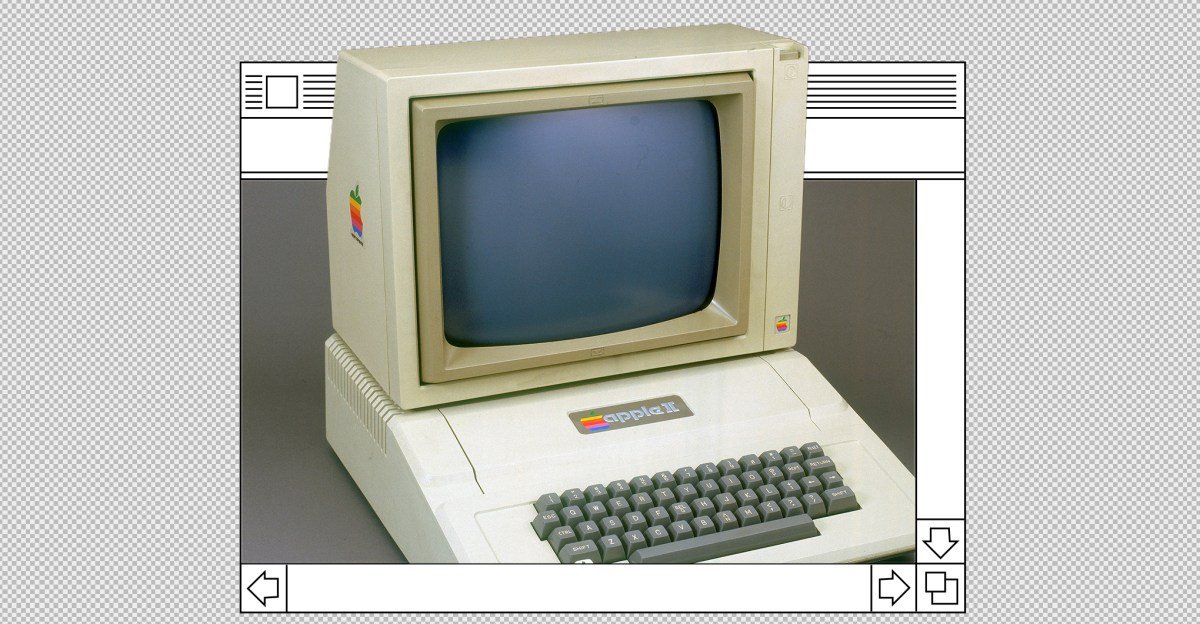
Apple would never have made it if it weren’t for the Apple II, the company’s first hit product and the first one to generate the amount of devotion we’ve now come to expect from fans of Apple’s products. Their slogan was, and still is, “Apple II Forever!”

1977 Apple II advertisement

1977 Apple II advertisement
Macmothership.com

Let’s go back to the dawn of consumer tech: the 1970s. The first personal computers emerged in this era, but they were largely sold as DIY kits. You’d buy a circuit board, separately buy all the chips and other elements required to assemble the computer (switches, keys), and put the whole thing together yourself. Apple’s first computer (the Apple I, designed by Steve Wozniak) was sold this way, too.

The first computer made by Apple Computers Inc. Most home computer users in the 1970s were hobbyists who designed and assembled their own machines. The Apple I, devised in a bedroom by Steve Wozniak, Steven Jobs and Ron Wayne, was a basic circuit board to which enthusiasts would add display units and keyboards.

The first computer made by Apple Computers Inc. Most home computer users in the 1970s were hobbyists who designed and assembled their own machines. The Apple I, devised in a bedroom by Steve Wozniak, Steven Jobs and Ron Wayne, was a basic circuit board to which enthusiasts would add display units and keyboards.
Photo by SSPL/Getty Images

In 1976, the owner of an early computer store, the Byte Shop, surprised Steve Jobs by suggesting that Apple would sell more computers if they came preassembled. Apple also experimented with wooden cases that you could put all the bits inside. Jobs quickly realized that Wozniak’s next design could reach a much bigger audience if it was packaged as a consumer product complete with built-in keyboard and set about figuring out how to make a plastic case for that preassembled computer.

Released in 1977, the Apple II was a beige plastic computer with an included keyboard. You had to plug it into a monitor or television, which you could stack right on top. The computer itself cost $1,298 (the equivalent of $7,000 today) — monitor sold separately. It felt more like a real product than anything else the personal computer world was churning out.

These were very primitive machines. The Apple II could generate rudimentary color graphics, but you ran it and programmed it by typing commands. You’d either get results, or if you missed a keystroke, error beeps combined with a response like ?SYNTAX ERROR. You could type in computer programs or load them in by attaching a cassette tape player (the same as you’d later find in a Sony Walkman) and pressing play, which would translate a digital whine recorded onto the tape into a runnable program.

Instructor Sally Waisbrot teaching Jonathan Schoor during a session at ‘Computer Camp East’ in East Haddam, Connecticut, July 16th 1981. A television set at back is functioning as a display for the Apple II computer.

Instructor Sally Waisbrot teaching Jonathan Schoor during a session at ‘Computer Camp East’ in East Haddam, Connecticut, July 16th 1981. A television set at back is functioning as a display for the Apple II computer.
Photo by UPI/Bettmann Archive/Getty Images

Apple sold enough of those initial Apple II models to get some momentum, but loading programs by cassette was slow and miserable. Something needed to be done, so Jobs found a company that made a 5.25-inch floppy disk drive. Rather than use the supplier’s design, Apple arranged to buy them half-assembled for a deep discount. Wozniak then designed a new, cheap, elegant controller board for the drive that outdid the supplier’s design — a dazzling engineering achievement that also happened to benefit the bottom line. By June 1978, Apple had the most affordable disk drive on the planet. More importantly, it was now much easier to write and save programs — and to buy and sell software. The Apple II software world exploded, which led to even more computer sales. The company’s revenue grew 640% in 1979 and 230% in 1980.

Wozniak is now famous for being famous, the “other Steve” who makes public appearances, was on Dancing with the Stars, is frequently quoted about anything Apple related, and is just a friendly, adorable guy. But the Apple II really was a triumph of his engineering prowess. While other computers required you to type in commands to get them up and running, Wozniak made sure that the Apple II was functional the moment it was powered on, and capable of running BASIC programs right out of the box.

Steve Wozniak, designer of the Apple II, sits with one of the machines, which was the most successful personal computer of its day

Steve Wozniak, designer of the Apple II, sits with one of the machines, which was the most successful personal computer of its day
Photo by Roger Ressmeyer/Corbis/VCG via Getty Images

The Apple II was not necessarily the most practical purchase for a family to make (that floppy disk drive added $600 to the price), but in those days, parents really did feel like their kids would face an unpleasant future if they weren’t exposed to computer technology. (Ask a nearby Gen Xer you know about how important it was to “learn computers” if you don’t believe me.) Parental interest combined with an aggressive program to sell the Apple II to schools created a playground for millions of kids to explore what might be possible. Happily for us, the Apple II was a pretty amazing toy to play around with even if you didn’t know the first thing about how computers worked.

Literally everyone started by writing a program that printed something like “JASON IS AWESOME” on an infinite loop, but many of us progressed to other things. The Apple II’s sound and graphics were still enough to play early computer games (The Oregon Trail, Castle Wolfenstein, Lode Runner, Karateka, and many more) with much more sophistication than what was offered at the local arcade. In hindsight, the amount of school time my classmates and I spent playing the Ultima series of roleplaying adventures seems inappropriate!

Production engineer Tom Beier examines a new Apple IIC keyboard at the Apple Computer plant in Dallas, TX on April 24th, 1984. The IIC is the portable version of the company’s successful II family of computers.

Production engineer Tom Beier examines a new Apple IIC keyboard at the Apple Computer plant in Dallas, TX on April 24th, 1984. The IIC is the portable version of the company’s successful II family of computers.
Photo by Bettmann/CORBIS/Bettmann Archive

Then came the moment when personal computers really became worth the money: In 1979, two guys from New England invented the spreadsheet program. It was Microsoft Excel’s great-grandmother, a program called VisiCalc, and it could vastly improve productivity for any bookkeeper or accountant accustomed to manually tabulating numbers on paper. The Apple II was more expensive than some of its competitors, but that meant it had better specs — and so the inventors of VisiCalc decided it would be the perfect platform for their idea. VisiCalc was initially released exclusively for the Apple II, and sales of the computer increased tenfold.

With all of this success, you might be surprised to learn Apple’s big plan for the Apple II in the 1980s: The company kept trying to replace it with a next-generation computer, yet somehow never seemed to get it right.

As the personal computer industry began a decade of explosive growth, every computer company was plotting its next move. The industry wasn’t a clash of a few titans back then — until the arrival of the IBM PC created the standardized format of hardware and software that led to PC clones and the rise of Microsoft, there were countless companies offering their own hardware and their own (incompatible) operating systems.

(In some ways, Apple owes its product philosophy to this day — make both the hardware and the software that runs on top of it — to the early days. Everyone else went out of business or ended up throwing their lot in with Microsoft, but not Apple.)

With all that competition, it was a death sentence for a company to sit still, so Apple tried to take all the money it was making on the Apple II and spend it on building the next great computer that would launch Apple into the stratosphere. While the company created the Apple II Plus in 1979 to keep its cash cow relevant, it was already planning its replacement: the Apple III.

macmothership.com

Targeted at a business audience of between $4,000 and $7,500 (between $15,800 and $29,700 in 2026 dollars), the Apple III was an expensive, buggy, incompatible system that — shocker — nobody wanted to buy! (To this day, it’s the reason there are few if any Apple products containing the number three.) In response, Apple retrenched and released the Apple IIe in 1983. I had one. I loved that thing. It improved on the Apple II Plus in every single way, from proper support for upper and lower case to the introduction of the “Apple” modifier key that lives on today as the Command key. It was amazing.

But even then, Apple was plotting to kill it with a new generation of computers that were powered by mouse-driven graphical interfaces, rather than the unabashedly command-line-oriented Apple II. So the company built a replacement — just probably not the one you’re thinking of. The Lisa, first released in early 1983, was also expensive ($10,000 in 1983, $32,800 today) and buggy. Its time on Apple’s price lists was ultimately much shorter than the Apple IIe’s.

Eventually, Apple did get the mouse-driven system right, with the Macintosh. But history would have you believe that once Steve Jobs’ famed “computer for the rest of us” shipped in early 1984, the Apple II era rapidly came to an end.

That still didn’t happen.

Right after the original Mac arrived, Apple shipped the Apple IIc, an ultra-compact model designed to appeal to consumers with limited desk space, and to schools. While early Mac sales fell short of Apple’s expectations, the Apple II series continued to be a big seller throughout 1984 and 1985.

Finally, in the mid-1980s, after CEO John Sculley famously ejected Steve Jobs from the company and a more appealing set of Mac designs appeared, sales did begin to pick up. Even then, however, Apple wasn’t done with the Apple II. In 1986, it released the Apple IIgs, which was a strange hybrid of Apple II software and Mac-style features, like support for a mouse and a graphical interface complete with a Finder app for managing files.

The Apple IIgs wasn’t discontinued until 1992, and the IIe kicked around until 1993. Though sales had obviously fallen through the floor by then, it’s kind of mind-blowing to think that some people were still buying Apple II computers in the era of Nirvana’s Nevermind.

CUPERTINO, CALIFORNIA JANAURY 24: Steve Jobs, left, and John Sculley host the annual Apple Computer show at Flint Center. Sculley is leaning on the Apple “Lisa” personal computer which succeeded the original Macintosh, on which Jobs is leaning. The 1984 annual meeting was the predecessor of what would become the MacWorld show the next year.

CUPERTINO, CALIFORNIA JANAURY 24: Steve Jobs, left, and John Sculley host the annual Apple Computer show at Flint Center. Sculley is leaning on the Apple “Lisa” personal computer which succeeded the original Macintosh, on which Jobs is leaning. The 1984 annual meeting was the predecessor of what would become the MacWorld show the next year.
Photo by Cap Carpenter/MediaNews Group/The Mercury News via Getty Images

Yes, the Mac ultimately became Apple’s standard-bearer and drove the bulk of the company’s revenue in the ’90s, but that transition came much later than most people would imagine. Apple could afford to advance the Mac because the Apple II just kept percolating along in the background, teaching kids how to program and helping businesses balance their books, despite the company’s best efforts to replace it.

The Lisa, original Mac, and even the Apple III were so superior to the Apple II in so many ways. What the Apple II had going for it was simplicity and affordability. For a company ruthlessly focused on the future, it must have been frustrating for Apple that one of their oldest computers was the one people kept wanting to buy. But for those of us who grew up with the Apple II, its charisma was undeniable. It was, in many ways, the definitive personal computer of the era.


Follow topics and authors from this story to see more like this in your personalized homepage feed and to receive email updates.

  • Jason Snell

    Jason Snell

    Posts from this author will be added to your daily email digest and your homepage feed.

    See All by Jason Snell

  • Apple

    Posts from this topic will be added to your daily email digest and your homepage feed.

    See All Apple

  • Tech

    Posts from this topic will be added to your daily email digest and your homepage feed.

    See All Tech

admin

admin

Next Post
The origin story of Apple’s long-running relationship with Foxconn

The origin story of Apples long-running relationship with Foxconn

Recommended.

Microsoft Edge is about to lock out older ad blockers, just like Chrome did

Microsoft Edge is about to lock out older ad blockers, just like Chrome did

August 8, 2026
Apple’s new M6 chip gets more cores and more AI compute

Apple’s new M6 chip gets more cores and more AI compute

August 25, 2026

Trending.

To regain advertiser trust, Facebook is tracking ads by the millisecond

October 15, 2025

Google has been asked to take down over a million websites

October 13, 2025

Shopify CEO attempts to defend continued hosting of Breitbart’s online store

October 8, 2025
Huawei made a whole camera to attach to its latest phone

Huawei made a whole camera to attach to its latest phone

October 1, 2026
HP’s answer to the MacBook Neo is thinner, lighter, and comes with OLED

HP’s answer to the MacBook Neo is thinner, lighter, and comes with OLED

October 1, 2026
earmpro tech news

Stay ahead of the tech curve. Our website delivers clear, concise updates on the latest gadgets, AI breakthroughs, and software, empowering your digital future.

Follow Us

  • About
  • Advertise
  • Privacy & Policy
  • Contact

© 2025 | Website Made By earmpro.com.

No Result
View All Result
  • Home
  • Review
  • Apple
  • Applications
  • Computers
  • Gaming
  • Gear
    • Audio
    • Camera
    • Smartphone
  • Microsoft
  • Photography
  • Security

© 2025 | Website Made By earmpro.com.